
Table of Contents
Last updated & prices checked: November 2026. A “professional” espresso machine for home use — usually called a prosumer machine — is not a pod machine or a pressurised-basket starter model. It means commercial-style parts: a 58mm (or quality 54mm) portafilter, a real boiler or fast thermoblock, stable brew temperature (ideally PID control), a proper steam wand, and the ability to pull repeatable shots back to back. Below are the 7 machines that meet that bar at home, compared on specifications, price and who each one actually suits.

How this list was built: CoffeeAware is a research-based site. We compared manufacturer specifications, authorised-retailer listings and current prices, and cross-checked them against what experienced home baristas and professional reviewers consistently recommend. We do not claim hands-on testing. Prices change often — the figure under each machine is the US price we checked in November 2026, so always confirm the live price before buying.
Quick Picks — Best Professional Espresso Machines for Home
| Product | Coffee Type | Standout Feature | Best For | Check Price |
|---|---|---|---|---|
| Gaggia Classic Pro | Semi-Automatic Espresso | Commercial 58mm portafilter with 3-way solenoid valve | Budget-minded espresso enthusiasts | View on Amazon |
| Breville Barista Express BES870 | Semi-Automatic Espresso | Built-in conical burr grinder — a true all-in-one | Beginners who want everything in one machine | View on Amazon |
| Breville Barista Pro BES878 | Semi-Automatic Espresso | ThermoJet system heats up in about 3 seconds | Home baristas who want speed | View on Amazon |
| Lelit Victoria PL91T | Semi-Automatic Espresso | PID control with pre-infusion via the LCC display | Detail-focused baristas with small kitchens | View on Amazon |
| Breville Dual Boiler BES920 | Semi-Automatic Espresso | Separate brew and steam boilers, PID on both | Serious baristas making back-to-back drinks | View on Amazon |
| Ascaso Steel Duo PID | Semi-Automatic Espresso | Dual thermoblock with volumetric dosing — brew and steam together | Milk-drink lovers who hate waiting | View on Amazon |
| Lelit Bianca V3 | Semi-Automatic Espresso | Flow-control paddle, dual boilers and a rotary pump | Advanced baristas wanting cafe-level control | View on Amazon |
Budget warning most roundups skip: Five of these seven machines have no grinder. A capable espresso grinder (budget roughly $200–$500) matters more to shot quality than the jump from a $1,200 machine to a $3,000 one. Budget for the grinder first.
The 7 Best Professional Espresso Machines for Home, Compared
1. Gaggia Classic Pro
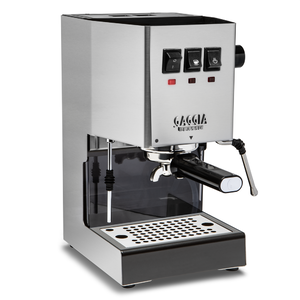
- Machine Type: Semi-Automatic
- Boiler: Single
- Capacity: 2.1 Liters
- Pressure: 15 Bars
- Dimensions: 8″ x 9.5″ x 14.2″
The Classic Pro is the cheapest machine on this list that behaves like a small commercial machine: a 58mm chromed-brass portafilter and group, a three-way solenoid valve (so pucks come out dry and pressure releases properly), a commercial-style steam wand, and a steel body built in Italy. There is no PID, so temperature surfing is part of the routine, and you must wait between brewing and steaming because it is a single boiler.
Who it suits: Beginners who are serious — and anyone on a budget who wants real espresso technique instead of pod convenience. We compared it directly with Breville’s all-in-one in our Gaggia Classic Pro vs Breville Barista Express breakdown.

2. Breville Barista Express BES870
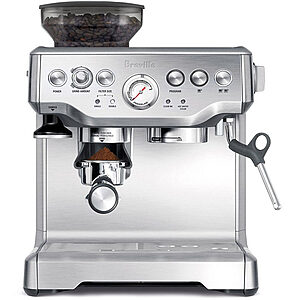
- Machine Type: Semi-Automatic
- Boiler: Thermocoil
- Capacity: 2 Liters
- Pressure: 15 Bars
- Dimensions: 12.5″ x 13.8″ x 15.9″
The Barista Express stays on this list because it is the machine most home users actually start their prosumer journey with: a built-in conical burr grinder, low-pressure pre-infusion, a pressure gauge, and a 54mm portafilter in one box. Its list price is $699.95 and it is very frequently discounted to around $500, which is why it outsells everything else here. What keeps it below the dedicated machines: the 54mm basket and thermocoil give you less temperature stability and a smaller aftermarket than 58mm boiler machines.
Who it suits: First-time buyers who want one box, one purchase, and cafe-style drinks this weekend. Full details in our Breville Barista Express BES870 review.
3. Breville Barista Pro BES878
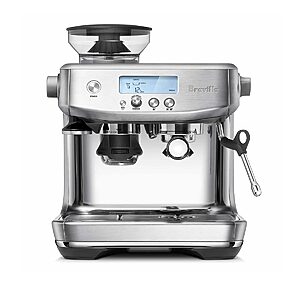
- Machine Type: Semi-Automatic
- Boiler: ThermoJet
- Capacity: 2 Liters
- Pressure: 15 Bars
- Dimensions: 12.2″ x 12.7″ x 15.7″
The Barista Pro is the Barista Express formula with the two biggest quality-of-life upgrades: Breville’s ThermoJet system reaches brew temperature in about 3 seconds, and an LCD screen with a more capable 30-setting built-in grinder replaces the analogue dials. At its $849.95 list price you are paying for speed and convenience rather than a step up in cup ceiling — the 54mm group and single-heater design still mean brewing and steaming take turns.
Who it suits: Busy households — including freelancers and home-workers making drinks between calls — who will not wait 10–30 minutes for a boiler.
4. Lelit Victoria PL91T
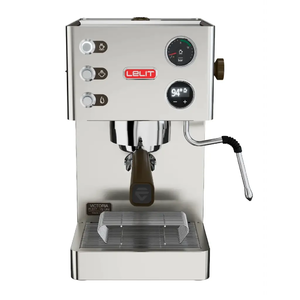
- Machine Type: Semi-Automatic
- Boiler: Single
- Capacity: 2.5 Liters
- Pressure: 15 Bars
- Dimensions: 9″ x 15″ x 15″
The Victoria is where this list turns fully “pro” while staying under $1,000: an Italian single boiler (0.3L brass) with PID temperature control managed through Lelit’s LCC display — the same control-centre family used on the flagship Bianca further down this list — which also handles pre-infusion settings and doubles as a shot timer. The group is a proper 58mm, there is a three-way solenoid valve, a generous 2.5L water tank, and the whole machine is only about 23cm wide — the narrowest footprint on this list. Like every single boiler it brews or steams, not both at once; expect roughly a minute and a half to switch over to steam.
Who it suits: Espresso-first home baristas — including the detail-focused engineers and freelancers who find this page — who want repeatable, precisely controlled shots from a small counter footprint and usually make one milk drink at a time.
5. Breville Dual Boiler BES920
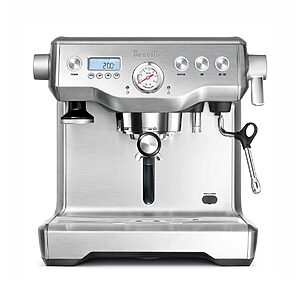
- Machine Type: Semi-Automatic
- Boiler: Dual
- Capacity: 2.5 Liters
- Pressure: 15 Bars
- Dimensions: 16.25″ x 15″ x 17.9″
Despite the Breville badge, the Dual Boiler is a different species from the Barista line: two stainless boilers let you extract espresso and steam milk at the same time, the brew boiler is PID-controlled, the portafilter is a full 58mm taking a 22g dose, and pre-infusion is programmable. At $1,599.95 it undercuts other dedicated dual boilers (for comparison, the Rancilio Silvia Pro X is around $2,195) by a wide margin. There is deliberately no grinder — Breville expects you to buy a serious one.
Who it suits: Households making several milk drinks in a row, and upgraders from a Barista Express who want the commercial workflow without crossing $2,000.
6. Ascaso Steel Duo PID
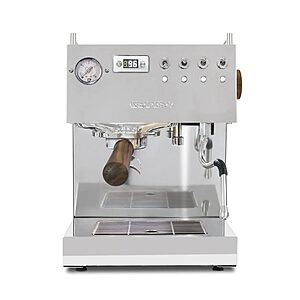
- Machine Type: Semi-Automatic
- Boiler: Dual Thermoblock
- Capacity: 2 Liters
- Pressure: 20 Bars
- Dimensions: 10.5″ x 12.5″ x 15″
Spanish maker Ascaso takes a different route: instead of boilers, the Steel Duo PID uses two separate thermoblocks — one for brewing, one for steam — so it can brew and steam simultaneously like a dual boiler, but with heat-up in minutes and no boiler water sitting stagnant. You also get PID temperature control in one-degree steps, volumetric shot programming, an adjustable OPV, and a 58mm portafilter with wooden handle, in a metal body that looks closer to cafe equipment than kitchen appliance. US pricing from Ascaso’s own store is $2,095.
Who it suits: Design-conscious buyers who want dual-heating performance without a 30-minute warm-up or plumbing, and who make mixed drinks through the day.
7. Lelit Bianca V3
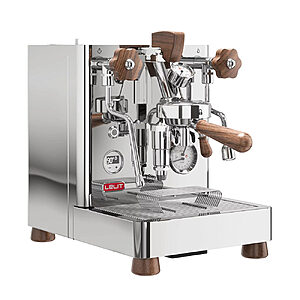
- Machine Type: Semi-Automatic
- Boiler: Dual
- Capacity: 2.5 Liters
- Pressure: 15 Bars
- Dimensions: 11.4″ x 19.1″ x 15.7″
The Bianca V3 is the ceiling of this list: an Italian dual boiler (0.8L brew + 1.5L steam) with an E61-style group, a quiet rotary pump, PID control of both boilers via the Lelit Control Centre display — and the feature nothing else here offers at the price, a manual flow-control paddle on the group that lets you shape pressure during the shot: gentle pre-infusion, a slow ramp, a declining finish. US retailers list it around $2,999.95 (list ~$3,399). It can also be plumbed in. The trade-offs are real: 30–40 minutes to fully heat, a large footprint, and technique that takes weeks to reward you.
Who it suits: Experienced home baristas — the prosumer endgame — who want to experiment with pressure profiling and keep a machine for a decade.
Buying Guide — What “Professional” Actually Requires
Boiler vs thermoblock vs dual boiler
Single boilers (Gaggia Classic Pro, Lelit Victoria) brew and steam from one boiler, so milk waits ~a minute after the shot. Dual boilers (Breville Dual Boiler, Bianca) do both at once — the single biggest workflow upgrade. Dual thermoblocks (Ascaso) split the difference: simultaneous work, fast heat-up, slightly less steam stamina. ThermoJet/thermocoil Brevilles heat instantly but brew and steam in turns.
58mm vs 54mm portafilter
58mm is the commercial standard: deeper baskets, better extraction headroom, and a huge accessory market (precision baskets, bottomless portafilters, tampers). Breville’s 54mm machines are easier and cheaper to start with, but the ecosystem is smaller.
PID control
PID holds brew water at a set temperature instead of cycling around it. It is the difference between “usually good” and repeatable — and it matters more as beans get lighter and more expensive.
The grinder rule
For every machine without a built-in grinder, reserve $200–$500 for a proper espresso grinder before upgrading the machine budget. A $1,200 machine with a $300 grinder beats a $3,000 machine with a $100 grinder, every time. If the total budget is under ~$600 all-in, start with our guide to the best espresso machines under $600 instead, or browse all head-to-head tests in our coffee machine comparisons.
FAQs
What makes an espresso machine “professional” for home use?
Commercial-style fundamentals: a 58mm (or quality 54mm) portafilter with a non-pressurised basket, a boiler or high-end thermoblock, stable temperature (ideally PID), a three-way solenoid or equivalent, and a real steam wand. Pod machines and pressurised-basket models are excluded from this list on purpose.
Which professional espresso machine do pros most recommend for home?
It depends on budget: the Lelit Victoria PL91T is the most-recommended compact PID machine under $1,000, the Gaggia Classic Pro is the long-standing value recommendation, and the Lelit Bianca V3 is the most-recommended high-end machine with flow control. All three appear above with their trade-offs stated.
Do I need a separate grinder?
For the Gaggia, both Lelit machines, the Dual Boiler and the Ascaso — yes, none has one built in. Only the two Breville Barista models include a grinder.
Can a home prosumer machine match cafe espresso?
Yes — the limiting factor is almost never the machine. With fresh beans, a good grinder and a few weeks of practice, every machine on this list can produce cafe-level shots; the more expensive ones mainly add speed, stability and control.
How long do these machines take to heat up?
From ~3 seconds (Barista Pro) and a few minutes (Ascaso, Lelit Victoria) to 10–15 minutes (most boilers) and 30–40 minutes for the E61-style Bianca to fully stabilise.
Final Thoughts
If you want the short version: buy the Gaggia Classic Pro if budget rules, the Barista Express if you want everything in one box, the Lelit Victoria if PID precision in a small footprint is the goal, the Breville Dual Boiler for milk-drink workflow under $2,000, and the Lelit Bianca V3 if you are buying the machine you intend to keep for ten years. Whichever you choose, spend on the grinder and fresh beans first — that is what professional results are actually made of.


